
Call the Chaplain!

Spoiler alert for one story arc in The Pitt, season 2, episodes 5,6,9 & 10.
“Where’s the chaplain?!” I exclaim.
I turn toward my wife, Sally, sitting next to me on the couch and convert the question into a quieter, equally urgent statement.
“They need a chaplain.”
Murmuring words of agreement, she pats my knee and I return my gaze to the images moving across the television screen.

We’re catching up on the second season of HBO’s hospital drama, The Pitt, and I’m losing my mind over the lack of spiritual care services offered in the hospital’s emergency department.
In this storyline, a 40-something woman, Roxie Hamler, who has an advanced cancer and receives hospice care at home, is in the emergency department after suffering a seizure and passing out. Reflexively, her husband calls 911 and an ambulance brings her to the Pitt. Due to her pain level and her emerging concerns about how her dying at home might affect her family longterm, Roxie chooses to remain hospitalized. She requests more medication to address her growing pain, knowing that the dosage will likely hasten her death.
In a quiet scene, Roxie sits in a hospital bed. She’s covered with a blanket from home. Family photographs line a side table. Dr. Cassie McKay, a resident about Roxie’s age, sits by the bed.
Roxie Hamler: It feels like a cruel joke. Why give me children and a husband I adore if you’re just going to take it away from me. For what? Fucking lung cancer. I didn’t even smoke.”
(She pauses.) Do you believe in God?Dr. Cassie McKay: I like the concept.
Roxie Hamler: I’m sure you’ve seen a lot of death.
Dr. Cassie McKay: I have seen my share.
Roxie Hamler: Any advice? (She pauses, her eyes grow teary.) I’ve never died before.
Dr. Cassie McKay looks stricken.
The scene cuts. The viewer sees them through a glass door.
The Pitt, Season 2, Episode 9 “3:00 PM” (my unofficial transcript)
I know “it’s not real.”1 It’s a television show—and the narrative is propelled by and for the main characters, i.e. Dr. Cassie McKay. But it’s also a medical drama that prides itself on matching its fiction with the reality of contemporary trauma medicine—and it falls short reflecting how spiritual care services support patients whose hospitalizations raise potent questions about life, illness and death.
In that scene, Roxie seeks companionship as she wrestles with profound questions. Why did this unfair, bad thing happen to me? How does God figure into this? Can you help me face this threshold I’m about to cross? So many important questions, but the writers only give Cassie short, declarative responses. What the writers don’t offer—and a clinical spiritual care provider would—is connection and curiosity. Who is the God that Roxie believes in—or doesn’t? Where does she find comfort? What’s underneath asking for advice about dying? What specific fears is she carrying?
The spiritual care provider2 would be listening, assessing and responding with the goal of supporting the patient, including meaning-making at the end of her life.
The Pitt gets credit for including Lena, a death doula in Roxie’s storyline. Responding to an intern’s question, Lena explains her work. “I’m Roxie’s death doula. … I help advocate for people like Roxie to make their transition to death a more peaceful process. It’s like a birth doula, but for the end of life.” I’d wager that some of the The Pitt’s 10 million viewers, like the medical student, Dr. Javadi, learned about death doulas from this episode, and that’s a good thing.
I give The Pitt a smidge of credit for giving Roxie Hamler important questions, but ultimately the questions—and her spiritual crisis—are forsaken.
Religion is a range of social-cultural systems, including designated behaviors and practices, ethics, morals, beliefs, worldviews, texts, sanctified places, prophecies, or organizations, that generally relate humanity to supernatural, transcendental, and spiritual elements—although there is no scholarly consensus over what precisely constitutes a religion.
Earlier this year, my online health portal requested I review my personal information. Was everything up-to-date? My preferred email and phone number, marital status, emergency contact. My religion?
As a former hospital chaplain, I regularly complete the “what is your religion” question on forms. I feel like I’m throwing my future spiritual care providers a bone. If I’m ever hospitalized, they’ll know the odds are good that the person in Room 483 will welcome their visit. And I will—unless I won’t. From being on the provider side of the bedrail, I know that “thanks, but not now” is accepted as equally as “come on in.”
Currently my religious preference on MyChart says “Unitarian.”3 I considered changing my preference to “Buddhist” but I felt resistance there, too, I don’t identify as a “Buddhist”—even though I’m currently exploring the path the Buddha laid out 2600 years ago. It probably doesn’t surprise you that “Attempting to follow the Buddha’s path of mindfulness” was not an option offered on the drop-down menu.
Surprisingly, Sutter Health (via My Chart) offers nearly ninety options. It’s an interesting list.
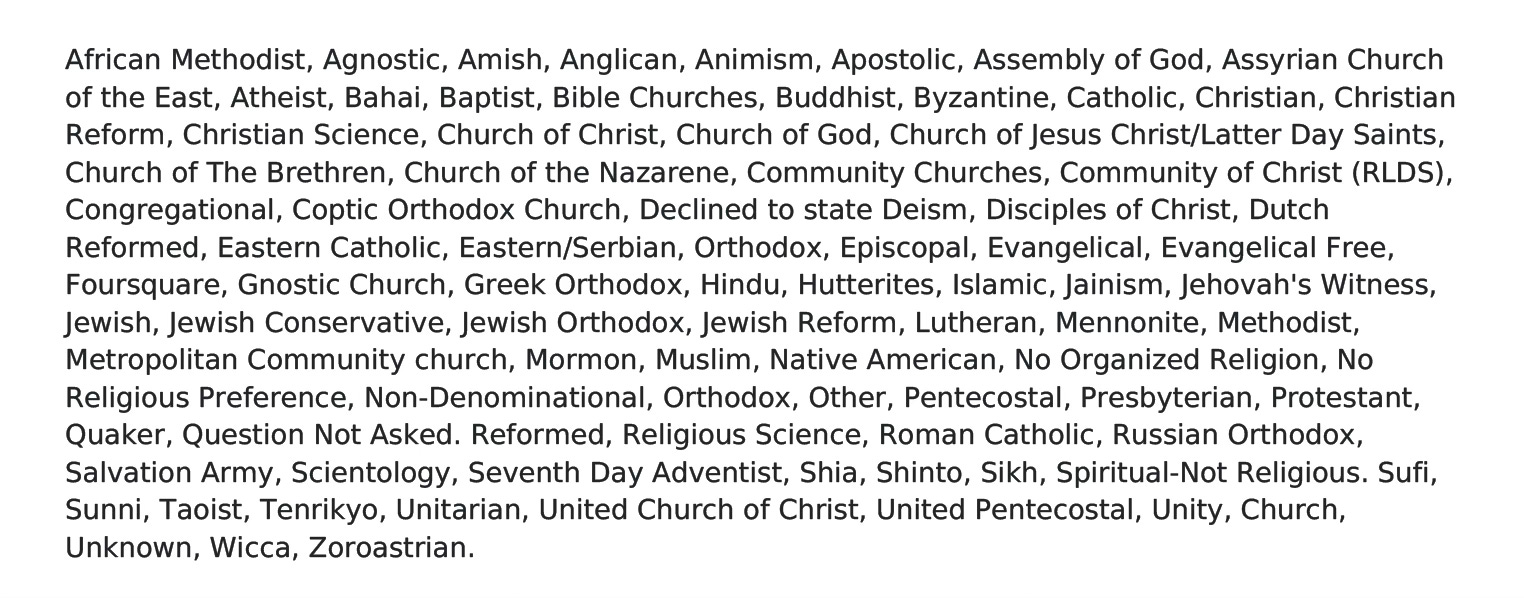
There are religions that are new to me (Caodai, a Vietnamese religion founded in the early 20th century) and also options of scope and specificity. A person can choose “Jewish” or more specifically Jewish Reform, Jewish Conservative or Jewish Orthodox. There are dozens of “Christian” options, the number pointing to the breadth of North American Christianity and how much variety that word holds. I’m glad to see “Metropolitan Community Church,” a queer Christian denomination.
Intriguingly, there are options for Atheist and for Agnostic, but not the third in the trinity, Theist. My guess is the portal developers figured that if a patient identified as one of the other religious identities, then Theist was already assumed. Erroneously, I’d argue.
So many options and nowhere near comprehensive—certainly nothing close to the 10,000 distinct religions believed to exist in the world!
The preferences extend beyond religions and denominations. Other options include “Spiritual—Not Religious,” “Other,” “No Religious Preference,” and “Declined to state.” I notice they didn’t use “Religiously Unaffiliated,” the group known informally as “the Nones” (not to be confused, phonetically, with nuns).4
The religiously unaffiliated population – often called religious “nones” – is the world’s third-largest religious category, after Christians and Muslims. This group includes people who in surveys and censuses answer a religious identity question by saying they do not have any religion or that they are atheist or agnostic.
Pew Research Center report, June 9, 2025
How the Global Religious Landscape Changed from 2010 to 2020
These are the some of robust spiritual, religious and non-religious identities that people bring with them to hospital emergency departments every day—along with the weighty uncertainties and anxieties that accompany every health crisis.
Here’s my wishlist for The Pitt, season 3: add a Spiritual Care Provider to the chaos and write some storylines that explore the 100 million North American “nones.” Show characters discerning meaning in the midst of suffering—outside the structure of well-known religious stories—and offer their effort the curiosity and richness it’s due.
🟥 🟥 🟥
While I focus on the nones here at Marking What Matters this week, I offer a Chag Sameach! to those celebrating the festival of Passover and blessings to those engaged in a Holy Week pilgrimage.
Thank you for reading Marking What Matters. I appreciate it.
Until next time,
Rachel
I’m using both “Chaplain” and “Spiritual Care Provider.” Part of the nuance/challenge is that “Chaplain” is regularly assumed to be Christian, even though it’s a title held by people of many faiths as well as humanist and non-religious staff. “Spiritual Care Provider” is a more recent term but doesn’t pleasantly roll off the tongue.
“Unitarian Universalist” isn’t offered as an option. My ministerial colleagues might join me in a collective eye roll; our affiliation hasn’t been solely “Unitarian” since 1961. It’s a bit of “inside baseball” but the inaccuracy bugs me.
I’m interested in the Nones and find Liz Bucar, a religious scholar who identifies as one, an interesting thinker. She posted a note on her Religion, Reimagined newsletter, curious about other possible monikers. You can find the responses here. I’m curious to see what her rebranding effort comes up with.
Hi Rachel,
I would add Earth as a spiritual orientation, the closest thing on your list may be Wicca, but for believing in the spiritual power of our home is more than Wicca
How do we tag The Pitt to let them know?